
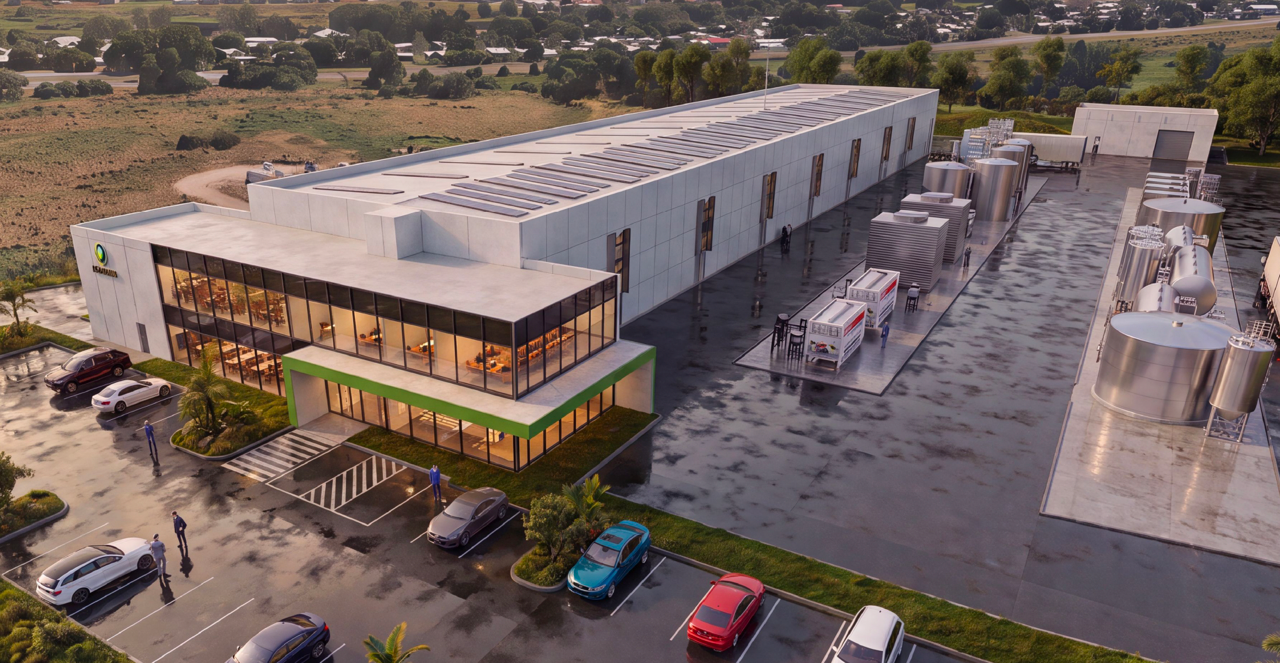
Pyrolysis Technology
Pyrolysis Technology Cairns — Waste to Energy
Advanced thermal conversion technology turning Far North Queensland's municipal solid waste into renewable diesel, electricity, and biochar — with reduced waste to landfill.
How Pyrolysis Works
Waste Reception & Sorting
Municipal solid waste is received from Cairns and FNQ councils. Recyclables, metals, and non-combustible materials are removed. The remaining organic and hydrocarbon-rich fraction is shredded and dried to optimise feedstock quality.
Pyrolysis Reactor
Prepared feedstock enters the pyrolysis reactor, where it is heated to 400–700°C in a completely oxygen-free environment. Without oxygen, combustion cannot occur — instead, long-chain hydrocarbon molecules are thermally decomposed into simpler compounds.
Output Separation
Three output streams are separated: a vapour that condenses into bio-oil for refining into renewable diesel, a non-condensable syngas used for on-site electricity generation, and a solid biochar residue for agricultural applications.
Product Refinement & Distribution
Bio-oil is upgraded into renewable diesel meeting Australian fuel standards. Syngas powers on-site generators with surplus electricity exported to the FNQ grid. Biochar is processed for distribution to Cairns-region agricultural operations.
Thermal Conversion Efficiency
Three Valuable Outputs
Each output has direct commercial applications across Far North Queensland. See full product details.
Renewable Diesel
Drop-in replacement for fossil diesel. Suitable for transport fleets, mining equipment, and industrial machinery across FNQ — no engine modification required.
Electricity
Syngas-powered on-site generation supplies the facility and exports surplus to the FNQ grid — dispatchable baseload renewable power, 24 hours a day.
Char
Stable carbon-rich soil amendment suited to tropical FNQ soils. Improves water retention and nutrient availability while sequestering carbon for centuries.

Frequently Asked Questions
Common questions about waste to energy pyrolysis technology in Cairns and Far North Queensland. Contact us if you have a question not covered here.
How does waste to energy work?
Waste to energy converts municipal solid waste into usable energy products through thermal processes. At Bioplant NQWTE Cairns, we use pyrolysis — heating waste to 400–700°C in an oxygen-free environment — to produce renewable diesel, electricity, and biochar. Unlike incineration, pyrolysis does not burn waste; it chemically converts it into valuable outputs with reduced waste to landfill.
Is pyrolysis safe for the environment?
Yes. The oxygen-free pyrolysis environment prevents the formation of dioxins and furans — the harmful emissions associated with open burning or incineration. Advanced gas treatment systems ensure all emissions meet or exceed Australian environmental standards. The process also eliminates landfill methane emissions, which are 25 times more potent than CO₂ as a greenhouse gas.
What types of waste can be processed?
The Bioplant NQWTE Cairns facility is designed to process municipal solid waste (MSW) — the general waste collected from households and businesses across Cairns and Far North Queensland. Recyclables and non-combustible materials are removed before processing. The remaining organic and hydrocarbon-rich fraction is ideal feedstock for pyrolysis.
How much waste can the facility process?
The facility is designed to process over 39,600 tonnes of municipal solid waste per year — equivalent to the annual waste output of a significant portion of Far North Queensland. This capacity is sufficient to extend the operational life of Cairns Regional Council's landfill by many years.
What happens to the renewable diesel produced?
The renewable diesel produced by Bioplant NQWTE Cairns is chemically equivalent to fossil diesel and can be used as a direct drop-in replacement in existing diesel engines — transport fleets, mining equipment, and industrial machinery — with no modification required. It is suitable for distribution across Far North Queensland and beyond.
What is MSW processing and why does North Queensland need it?
MSW processing — municipal solid waste processing — refers to the treatment of everyday household and commercial waste to recover resources or energy rather than sending it to landfill. North Queensland generates hundreds of thousands of tonnes of MSW each year, and existing landfill capacity is finite. Bioplant NQWTE Cairns provides a long-term solution by converting that waste into renewable diesel, electricity, and biochar, extending landfill life and reducing the region's environmental footprint.
How does pyrolysis differ from incineration?
Incineration burns waste in the presence of oxygen to generate heat and electricity, producing ash and flue gases that require careful management. Pyrolysis heats waste in an oxygen-free environment, chemically converting it into liquid fuels, combustible gas, and biochar without combustion. This means no open flame, no dioxins or furans from burning, and a higher-value set of outputs — particularly the renewable diesel and biochar that incineration cannot produce.
Is waste to energy technology proven in Australia?
Pyrolysis and advanced thermal waste treatment technologies are operating commercially across Europe, Asia, and North America, and are increasingly being adopted in Australia. Bioplant NQWTE Cairns draws on internationally proven technology adapted for the tropical climate and waste composition of Far North Queensland, with engineering designed to meet Australian environmental and safety standards.
What is biochar and how is it used in FNQ agriculture?
Biochar is a stable, carbon-rich solid produced when organic material is heated in low-oxygen conditions. When applied to soil, it improves water retention, nutrient availability, and microbial activity — benefits that are particularly valuable in the tropical soils of Far North Queensland. Cairns-region cane farmers and horticulture operations can use biochar to improve yields while sequestering carbon for hundreds of years, contributing to Queensland's climate targets.
How does the Bioplant NQWTE project benefit Cairns Regional Council?
The project offers Cairns Regional Council a long-term waste management solution that reduces dependence on landfill, lowers the cost and environmental risk of future landfill development, and supports Queensland's waste diversion targets. By processing over 39,600 tonnes of MSW per year, the facility can extend the operational life of the region's landfill by many years — deferring significant capital expenditure while delivering local jobs and renewable energy.
What renewable energy does the facility produce for FNQ?
The Bioplant NQWTE Cairns facility produces two forms of renewable energy: renewable diesel from the liquid hydrocarbon output of pyrolysis, and electricity from syngas-powered on-site generators. Surplus electricity is exported to the local grid, contributing to Far North Queensland's energy supply and supporting Queensland's renewable energy transition. The renewable diesel is suitable for use in transport, mining, and industrial applications across the region.
How does waste to energy in Cairns compare to landfill?
Landfill stores waste underground where it slowly decomposes, generating methane — a greenhouse gas 25 times more potent than CO₂ — and leachate that can contaminate groundwater. Waste to energy pyrolysis converts that same waste into renewable fuels, electricity, and biochar, recovering its energy value and eliminating landfill emissions. For Cairns and FNQ, it means less land consumed by waste, lower greenhouse gas emissions, and a local source of renewable energy rather than an ongoing liability.
What feedstock types are suitable for pyrolysis at the Cairns facility?
The Bioplant NQWTE Cairns facility is optimised for the mixed municipal solid waste (MSW) typical of Far North Queensland — including plastics, rubber, textiles, paper, cardboard, and organic residuals that cannot be economically recycled or composted. Commercial and industrial waste streams with similar hydrocarbon content are also suitable. Inorganic materials such as glass, metals, and concrete are screened out prior to processing and directed to appropriate recycling streams.
How much energy does the pyrolysis process produce per tonne of waste?
The Bioplant NQWTE Cairns process recovers over 85% of the energy content of the feedstock. For a typical tonne of FNQ municipal solid waste, this translates to approximately 300–400 litres of renewable diesel equivalent, plus electricity from syngas combustion and biochar as a co-product. The exact output ratio depends on feedstock composition and can be adjusted by varying reactor temperature and residence time to favour diesel, electricity, or biochar production based on market demand.
What are the environmental benefits of pyrolysis compared to other waste processing methods in FNQ?
Compared to landfill, pyrolysis eliminates methane emissions, prevents leachate contamination, and recovers the energy value of waste rather than burying it. Compared to incineration, it produces no dioxins or furans, generates higher-value liquid fuel outputs, and produces biochar for carbon sequestration. Compared to composting alone, it can process the full residual waste fraction — including plastics and non-organic materials — that composting cannot handle. For Far North Queensland, the combined effect is a significant reduction in greenhouse gas emissions, extended landfill life, and locally produced renewable energy.
What cost savings can Cairns Regional Council expect from waste to energy processing?
Councils partnering with Bioplant NQWTE Cairns can expect savings across several areas: reduced gate fees compared to the long-run cost of new landfill development; deferred capital expenditure on landfill expansion; reduced liability for landfill aftercare and remediation; and potential revenue from waste disposal contracts. The facility also reduces the cost of meeting Queensland's mandatory waste diversion targets, which carry financial penalties for non-compliance. Specific savings depend on contract terms, waste volumes, and the avoided cost of alternative disposal options.
What is the project timeline for Bioplant NQWTE Cairns?
Bioplant NQWTE Cairns is currently in the project development and stakeholder engagement phase. Key milestones include environmental impact assessment, development approval, detailed engineering design, and construction. The project team is actively engaging with Cairns Regional Council, Far North Queensland councils, and state and federal government agencies. Interested parties — including councils, industry partners, and investors — are encouraged to contact the team to discuss the project timeline and partnership opportunities.
What regulatory approvals does a waste to energy facility in Queensland require?
A waste to energy facility in Queensland requires approvals under the Environmental Protection Act 1994, including an Environmental Authority from the Department of Environment and Science covering air emissions, noise, water, and waste management. Development approval under the Planning Act 2016 is required from the relevant local council. The facility must also comply with the Waste Reduction and Recycling Act 2011 and relevant Australian Standards for air quality and emissions monitoring. Bioplant NQWTE Cairns is designed to meet or exceed all applicable Queensland and Australian regulatory requirements.
How does pyrolysis compare to gasification for waste processing in FNQ?
Both pyrolysis and gasification are advanced thermal waste treatment technologies, but they operate differently. Gasification uses a small amount of oxygen or steam to partially combust waste at very high temperatures (700–1,200°C), producing primarily syngas for electricity generation. Pyrolysis uses no oxygen and lower temperatures (400–700°C), producing a more diverse output mix — liquid bio-oil for refining into renewable diesel, syngas for electricity, and biochar. For Far North Queensland, pyrolysis's ability to produce renewable diesel — a high-value, locally usable fuel — alongside electricity and biochar makes it particularly well-suited to the region's energy and agricultural needs.
Can the Bioplant NQWTE Cairns facility process waste from regional councils beyond Cairns?
Yes. The facility is designed to serve the broader Far North Queensland region, not just Cairns Regional Council. Councils across FNQ — including Tablelands Regional Council, Mareeba Shire, Douglas Shire, and others — face the same landfill capacity and waste diversion challenges as Cairns. Bioplant NQWTE Cairns can accept waste from multiple council areas, with transport logistics and gate fee arrangements to be agreed on a council-by-council basis. Regional councils interested in exploring waste processing arrangements are encouraged to contact the project team.
What are the long-term legacy costs of a landfill compared to a pyrolysis facility?
A landfill carries significant legacy obligations that continue for decades after it stops accepting waste. Under Queensland's Environmental Protection Act, closed landfills require ongoing monitoring, leachate management, methane capture, and groundwater testing — costs that fall on councils and ratepayers for 30 years or more after closure. Contamination remediation, if required, can run into tens of millions of dollars. By contrast, a pyrolysis facility like Bioplant NQWTE Cairns buries nothing. There is no buried waste, no leachate, no methane generation, and no contaminated land. If the facility were ever to close, it leaves behind a clean industrial building that can be repurposed for any other commercial or industrial activity — with zero remediation liability and no ongoing monitoring obligations.
Why does a pyrolysis facility have no ongoing closure or remediation costs?
Because pyrolysis converts waste rather than storing it. Every processed tonne of municipal solid waste received at Bioplant NQWTE Cairns is thermally converted into renewable diesel, electricity, and biochar — nothing is buried in the ground. This means there is no contaminated land, no leachate plume, no methane-generating buried organics, and no legacy liability for future owners or the community. A decommissioned pyrolysis facility is simply a vacant industrial building. Compare this to a closed landfill, which requires decades of aftercare, environmental monitoring, and potential remediation at ratepayer expense — costs that are often underestimated at the time of approval and grow significantly over time.
How does avoiding landfill legacy costs benefit FNQ ratepayers?
Landfill closure and aftercare costs are a hidden long-term liability for every council that operates one. Queensland regulations require closed landfills to be monitored and managed for a minimum of 30 years post-closure, with costs for leachate treatment, gas management, and groundwater monitoring borne by the council — and ultimately by ratepayers. If contamination is detected, remediation costs can be substantial. Bioplant NQWTE Cairns eliminates this liability for the waste it processes. By diverting waste from landfill today, FNQ councils reduce the volume of buried waste that will generate future closure costs, protecting ratepayers from an obligation that compounds with every additional tonne sent to landfill.

Environmental Performance in Far North Queensland
Pyrolysis technology delivers measurable environmental benefits for Cairns and Far North Queensland compared to landfill disposal and fossil fuel production.
Greenhouse Gas Reduction
Diverting waste from landfill eliminates methane emissions — a greenhouse gas 25 times more potent than CO₂. Combined with renewable fuel production replacing fossil diesel, the project delivers significant net carbon reductions for Queensland.
No Harmful Emissions
The oxygen-free pyrolysis environment prevents the formation of dioxins and furans. Advanced gas treatment systems ensure all emissions meet or exceed Australian environmental standards — cleaner than conventional waste disposal.
Cairns Landfill Life Extension
Processing 39,600 tonnes of waste annually extends the operational life of Cairns Regional Council's landfill for many years, deferring the significant cost and environmental impact of new landfill development in Far North Queensland.
Carbon Sequestration
Biochar produced by the process locks carbon into Queensland's agricultural soils for centuries, providing a permanent carbon sink that contributes to Australia's net-zero emissions targets.
Ready to Learn More About Waste to Energy in Cairns?
Speak with our team about the technology, the project timeline, and how Bioplant NQWTE Cairns can partner with your organisation across Far North Queensland.